






Home > Governance
Governance
SIGA follows best practices while supporting First Nations communities through strategic partnerships and strong corporate governance.
The Conference Board of Canada/Spencer Stuart
2009 National Awards in Governance
SIGA won the 2009 National Award for Governance Excellence as determined by the Conference Board of Canada.
“SIGA has developed a governance framework with policies and procedures that are consistent with best business and governance practices in Canada. However, more importantly, they also align with the organization’s five guiding principles, allowing it to retain its identity and culture as a First Nations business.”
-2009 Conference Board of Canada/Spencer Stuart National Awards in Governance
Authority
Under the First Nations Gaming Act, the Federation of Sovereign Indigenous Nations Inc. (FSIN) created the Saskatchewan Indian Gaming Authority (SIGA) on June 10, 1995. The FSIN entered into the Gaming Framework Agreement (GFA) with the Province of Saskatchewan, which established its exclusive access to casino markets in Saskatchewan. SIGA was designated as the proponent for casino development and was then incorporated under The Non-Profit Corporation Act, 1995 of Saskatchewan on January 11, 1996.
In September 2021, an amendment to the GFA was signed between the FSIN and the Province to establish the legal framework for a new online gaming site, which will be run by SIGA. In November 2021 SIGA became the sole operator of online gaming for the Province of Saskatchewan.
Gaming Governance & Industry Oversight
In 2023, the Province of Saskatchewan created Lotteries and Gaming Saskatchewan (LGS) as a Crown Corporation to, amongst other things, conduct and manage lottery schemes and oversee the gaming sector in Saskatchewan pursuant to the Lotteries and Gaming Corporations Act from and after June 1, 2023. The launch of Lottery & Gaming Saskatchewan (LGS) now carries out the managerial oversight of all forms of gaming – replacing the roles previously carried out by three separate government ministries. SIGA’s operating agreement relationships will now be with LGS, while the Saskatchewan Liquor & Gaming Authority (SLGA) and Indigenous Gaming Regulators (IGR) undertakes regulatory responsibilities.
Our Structure
SIGA’s gaming operations are a revenue source for Saskatchewan’s First Nations, the Provincial Treasury and for the Community Development Corporations (CDCs). The CDCs distribute this money to charitable and non-profit community organizations. Profits generated from SIGA’s operations are administered by the Province of Saskatchewan using the following breakdown: 50% to Saskatchewan First Nations, as distributed through the First Nations Trust; 25% to the CDCs; and 25% to the provincial government’s General Revenue Fund.
Governance Practices
The SIGA Board has formally adopted a governance model with generally accepted governance practices, and a suite of corporate governance policies. These policies ensure continuity of good governance practices and provide ongoing direction for the Board, its committees, and management. To ensure that SIGA continues to exemplify high standards of corporate governance it mandates that the policies are reviewed by external parties.
Policies and Resource Links
- Board Mandate
- Code of Conduct Ethics – Directors
- Board Chair – Terms of Reference
- Governance Committee Mandate
- Audit Finance Committee Mandate
- Strategic Affairs Committee Mandate
- SIGA Board of Directors Biographies
Role of the Board
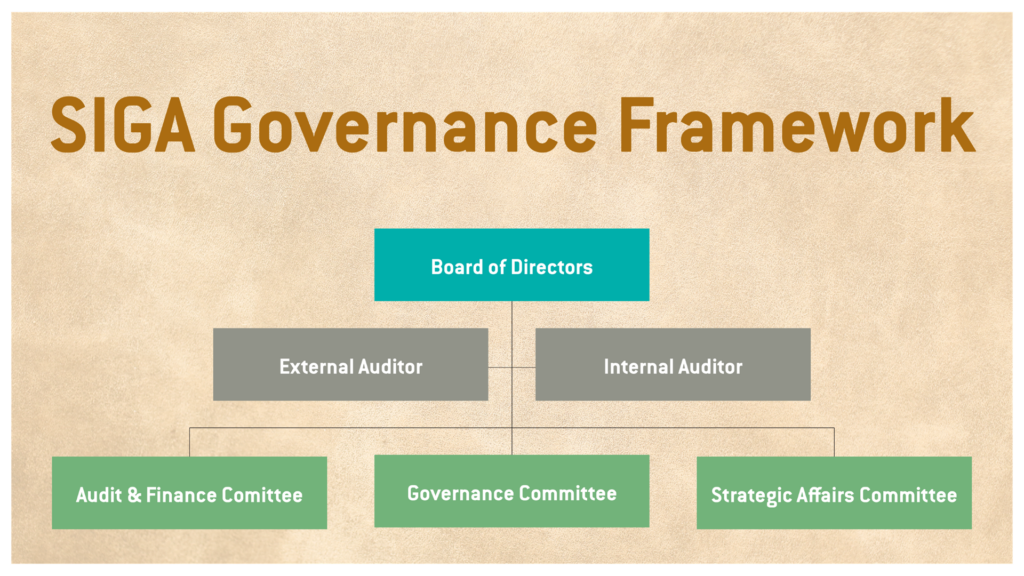
On behalf of the Shareholders, the Board of Directors is responsible for the stewardship of the organization and is ultimately accountable for the management of the affairs and business of SIGA. In meeting this responsibility, the Board works with management to develop and approve the organization’s strategic plan, annual budgets, and ensures that a communication policy is in place. The Board has established a terms of reference addressing its principal duties and responsibilities as a Board.
The Board of Directors is comprised of not more than thirteen members. The Federation of Sovereign Indigenous Nations and the Tribal Councils appoint these members to the Board, with one Director, with financial expertise being appointed by the Board. Only individuals registered under The Alcohol and Gaming Regulation Act, 1997 may be members of the SIGA Board.
First Nations Gaming Organization Structure
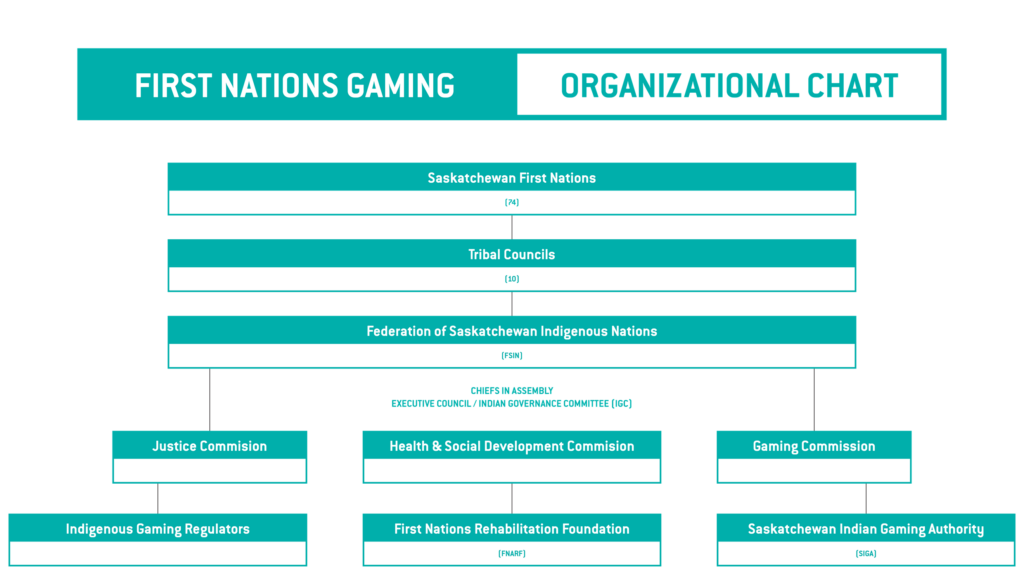
SIGA’S CORPORATE GOVERNANCE
AUTHORITY
Under the First Nations Gaming Act, the Federation of Sovereign Indigenous Nations (FSIN) created the Saskatchewan Indian Gaming Authority (SIGA) on June 10, 1995. The FSIN entered into the Gaming Framework Agreement (GFA) with the Province of Saskatchewan, which established its exclusive access to casino markets in Saskatchewan. SIGA was designated as the proponent for casino development and was then incorporated under The Non-Profit Corporation Act, 1995 of Saskatchewan on January 11, 1996.
The Province of Saskatchewan regulates SIGA through the Saskatchewan Liquor and Gaming Authority (SLGA) and the Indigenous Gaming Regulators (IGR). Accountable to the mandate set out by our shareholders, SIGA operates under the terms set out in the Casino Operating Agreement (COA) and gaming regulatory conditions established by IGR and SLGA.
LOTTERIES AND GAMING SASKATHCEWAN
In 2023 the Province of Saskatchewan created Lotteries and Gaming Saskatchewan (LGS) as a crown corporation to, amongst other things, conduct and manage lottery schemes and oversee the gaming sector in Saskatchewan pursuant to the Lotteries and Gaming Corporations Act from and after June 1, 2023. The launch of LGS now carries out the managerial oversight of all forms of gaming – replacing the roles previously carried out by three separate government ministries. SIGA’s operating agreement relationships are now with LGS while SLGA solely undertakes regulatory responsibilities.
SASKATCHEWAN LIQUOR AND GAMING AUTHORITY
The Province of Saskatchewan regulates SIGA through the Saskatchewan Liquor and Gaming Authority (SLGA) and the Indigenous Gaming Regulators (IGR). Accountable to the mandate set out by our shareholders.
OUR STRUCTURE
SIGA’s gaming operations are a revenue source for Saskatchewan’s First Nations, the Provincial Treasury and for the Community Development Corporations (CDCs). The CDCs distribute this money to charitable and non-profit community organizations. Profits generated from SIGA’s operations are administered by the Province of Saskatchewan using the following breakdown: 50% to Saskatchewan First Nations, as distributed through the First Nations Trust; 25% to the CDCs; and 25% to the provincial government’s General Revenue Fund.
The GFA amendment for online gaming established a revenue-sharing agreement between FSIN and the Province. The GFA establishes that profits generated by SIGA’s online gaming operations are administered by the Province of Saskatchewan using the following breakdown: 50% to Saskatchewan First Nations, as distributed by the First Nations Trust and 50% to the provinces General Revenue Fund.
ROLE OF THE BOARD
On behalf of the Shareholders, the Board of Directors is responsible for the stewardship of the organization and is ultimately accountable for the management of the affairs and business of SIGA. In meeting this responsibility, the Board works with management to develop and approve the organization’s strategic plan, annual budgets, and ensures that a communication policy is in place. The Board has established a Terms of Reference addressing its principal duties and responsibilities as a Board.
While focusing on the strategic direction of the organization, the Board delegates day-to-day operations to the President and CEO. The Board has resolved to adopt a policy governance model that empowers the President and CEO and holds them accountable for achieving the Board’s directives, managing risks, complying with the Casino Operating Agreement (COA) and Board policies. In addition, the organization has a comprehensive Delegation of Authority Policy that governs the approvals and spending authorities for all managers consistent with their responsibilities, accountabilities, and budgetary allocations. The policy specifies those matters that require Board approval, including items specific to capital expenses (including renovation projects) planned over $1,000,000; and unplanned over $500,000, including any property management, land and building leases, and all other operating expenses and contracts.
All of its Directors are independent of management and no member of management serves as a Director. The Board regularly holds four board meetings per year.
BOARD CHAIR – CHIEF TAMMY COOK-SEARSON
The Chair provides leadership by guiding the Board, coordinating its activities, and fostering relationships in the best interests of the organization. The Chair, while working closely with the President and CEO, retains an independent perspective to best represent the interests of SIGA, the Board, and the communities they serve. The Chair, on behalf of the Board, reports to the FSIN Gaming Commission and the FSIN Legislative Assembly on the affairs of the corporation, including all business aspects of casinos owned and operated by SIGA. The Chair, in turn, reports to the Board of Directors any recommendations brought forward by the Gaming Commission and the Assembly. The Board has delegated authority and assigned responsibility to the Board Chair for managing SIGA’s relationship with the Shareholders as per policy B03-012 Board Chair – Terms of Reference.
DIRECTORS
The Federation of Sovereign Indigenous Nations (FSIN) and the Tribal Councils nominate these members (one per Tribal Council). There is one independent director appointed by the SIGA Board who has financial expertise. Only individuals registered under The Alcohol and Gaming Regulation Act, 1997 may be Directors of the Board.
As per the Casino Operating Agreement (COA), the Board structure is comprised of no more than 13 Directors.
The current Directors are as follows:
- Chief Tammy Cook-Searson – Chair
- Chief Darcy Bear – Strategic Affairs Committee Chair
- Carole Bryant – Audit & Finance Committee Chair
- Chief Michael Starr – Governance Committee Chair
- Chief George Cote
- Vice Chief Richard Derocher
- Chief Cynthia Desjarlais
- Chief Calvin Sanderson
- Chief Jonathan Pasap
- Kevin Poock
- Chief Marie-Anne Day Walker-Pelletier
- Chief Lorie Whitecalf
COMMITTEE STRUCTURE
The Board may appoint any committees that it considers necessary for the efficient conduct of the affairs and business of SIGA and may prescribe the duties of any committee it appoints. It is important to note that the assignment of responsibility by the Board to a committee does not absolve the full Board from responsibility for a committee’s work or decisions. The Chair is ex-officio on all committees and may attend any meeting as deemed appropriate. All committees have established terms of reference governing their conduct and mandate.
The Board has three (3) committees with established terms of reference governing their code and mandate. These three committees are as follows: Audit and Finance, Governance (includes Human Resources, Compensation and Ethics), and Strategic Affairs.
AUDIT AND FINANCE COMMITTEE – CAROLE BRYANT, CHAIR
The Audit and Finance Committee monitors the financial performance and internal controls of SIGA, assesses risk management strategies, and acts as a liaison between the internal and external auditors and the Board. This committee is responsible for the internal audit function and has retained an independent internal auditor who is accountable to the Board through the Audit and Finance Committee and has unimpeded access to corporate information and reports. SIGAs internal auditor is BDO. The fee for the internal audit function for the entire fiscal year is $112,000. The committee monitors internal controls over the financial reporting process, auditing matters, and financial reporting issues. The SIGA audit is completed by the audit firm Deloitte LLP. The fee for the audit was $520,000 in 25-26. In addition to the statutory audit requirements, Deloitte LLP submits management letters that contain internal control recommendations and identify management and system control risks. Deloitte LLP has examined the corporation’s financial statements and issued an auditor’s report included in this annual report. Deloitte LLP did not provide any non-audit services this past fiscal year.
STRATEGIC AFFAIRS COMMITTEE – DARCY BEAR, CHAIR
The Strategic Affairs Committee is mandated to ensure there are sufficient processes in place to develop, maintain and monitor the strategic plan, provide direction on shareholder and stakeholder relations and review and provide direction on new business opportunities. The Strategic Affairs Committee is also responsible to review, assess and monitor strategic level risk in SIGA’s risk management plan and to ensure the appropriate risk mitigation strategies are in place. Further, the committee will review and provide recommendations on the Casino Operating Agreement and the Framework Agreement.
GOVERNANCE COMMITTEE – MICHAEL STARR, CHAIR
The Governance Committee is responsible for overseeing the Authority’s governance processes and the quality of its corporate governance, reporting to the Board concerning the same. The committee helps the Board deliver exemplary governance and human resource practices ensuring that SIGAs overall compensation structure provides appropriate incentives to employees at all levels. The committee ensures that SIGA is observing the highest standards of ethical business conduct. The Governance Committee monitors the functioning of the Board and committees of the Board and recommends governance issues to be discussed by the Board and Board committees. It is also responsible for ensuring timely and complete information and decision-making at the Board and committee levels. The Governance Committee is responsible for ensuring an annual review of the terms of reference of the Board and its committees. The committee coordinates the bi-annual evaluations of the Board, the Board Chair, and its committees.
The Governance Committee oversees the annual evaluation of the President & CEO and engaged Eckler, an independent third-party consulting firm, to conduct the evaluation of the President & CEO.
GOVERNANCE PRACTICES
The SIGA Board has formally adopted a governance model with generally accepted governance practices, and a suite of corporate governance policies. These policies ensure continuity of good governance practices and provide ongoing direction for the Board, its committees, and management.